
I have read quite a lot around this subject and when I first came across the idea, I was a little surprised and it took me a bit of reflection to identify some of the negative consequences in my own workflow. I had done a great job of convincing myself that I was actually quite good at multitasking. I would usually have at least 6 print out’s on my desk ordered in priority based on issues and opportunities, a to-do list, a calendar, WhatsApp, FT/Bloomberg open for up to date news and potentially a podcast or radio in the AirPods for good measure. I would take constant phone calls, even in the middle of meetings if i thought they were quick (bad etiquette I know). I definitely looked busy and to be honest I felt like I was getting a lot done. But there was a problem: usually I would feel tired and scattered, often frustrated with not actually getting as much done as I thought I was.
Even though I know multitasking feels like efficiency, science, and real experience, say it’s not. I wonder why it feels so tempting to fall back into it, even intra day when I think I have conquered this inefficiency habit, it still occasionally bites me in the arse. I am interested in revisiting this and seeing if I can make it easier for me to stay on track, so I thought Id lay out what I remember from previous research and what is new. Maybe some of it you can relate to and maybe you find some tips to help you also.
The Science on Multitasking (Spoiler: It’s Bad News)
The human brain, as powerful as it is, is not built to juggle multiple complex tasks at once. What we call ‘multitasking’ is actually task switching – jumping back and forth, burning mental energy every time. So often I will be in the middle of writing an email and there is a knock on my door (open door policy, which I am proud of) and instead of giving either my full attention, I often allow the interruption in the interest of efficiency but not giving it my full attention as mentally I am still finishing my email.
Attention limits are a real thing. Working memory can only hold so much, so details get lost. Interestingly, there are significant switching costs in taking this approach. Studies show productivity drops up to 40% when you switch tasks frequently. Brain fatigue also is legit! Each switch drains focus like opening too many apps at once on your phone.
So to summarise so far: Multitasking is not mastery; it’s mental whiplash.
Why We Keep Falling Into the Trap
Im saying ‘we’ here as looking at the plethora of research around this topic, it is clear this is not a ‘me’ or ‘I’ problem. If multitasking is so inefficient, why do we keep doing it? Because it feels good.
Im typing this – I literally just stopped mid sentence to pick up my phone and ‘quickly answer a whatsapp message’ despite only having another 5 minute before I need to head on the school run. And managed to also ‘send a quick’ email reply. Ahhhh! Annoying but actually helpful in me understanding the pitfalls that I fall into.
Urgency culture. Email, WhatsApp, Teams and endless notifications scream for attention. It also hits our dopamine loops. Switching tasks and ticking off small items gives us micro hits of ‘reward’. I think there is also something around a ‘busy illusion’. Whether this is just mental, or subconsciously presenting to others or a mix of both, having a lot of tabs open and notifications flowing feels like you are achieving more than you actually are.
The kicker? Multitasking looks like productivity, but is really procrastination is disguise.
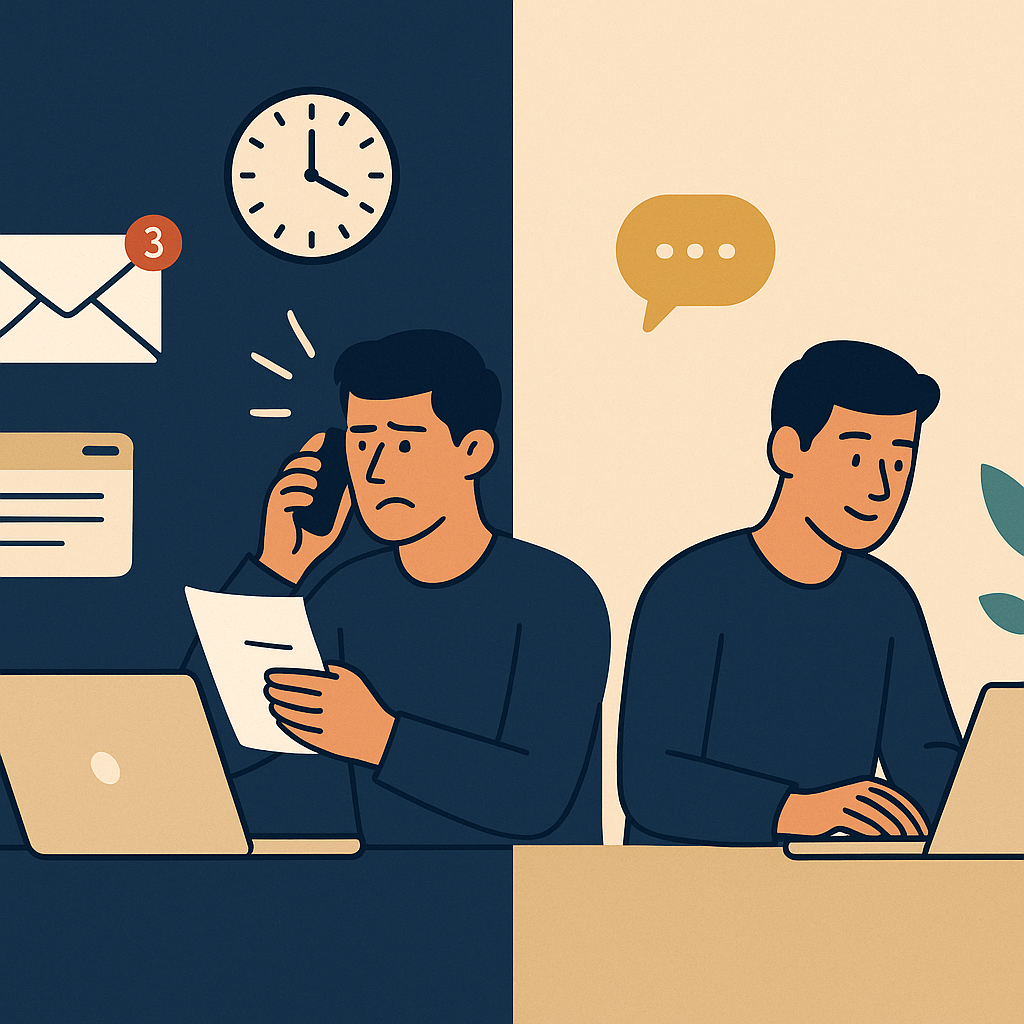
Work and Hobby Crossover: Same Trap, Different Disguise
Interestingly this does not only seem to apply to my work life. Ever notices that hobbies fall into the same pattern?
For me, one minute I am researching an idea, them I am watching a pinterest tutorial for designs and have a YouTube video open for blog growth. It feels like progress and learning different elements but I end up with no finished blog post and well, a bit drained.
Play, therefore, seems to not be immune. The switching costs seem to follow me into both work and play.
Why Multitasking Feels Productive (But Isn’t)
It tricks you. It certainly tricks me.
You get visible busyness with open tabs, multiple draft emails, moving parts and generally lots of activity. This leads to the feeling of racking up lots of small wins with quick replies but they are generally shallow tasks. But you have satisfied urgency even if it is to the detriment of importance.
What I want to be searching for and spend more time doing is deeper, higher-value work. Work that moves me forward. The thing that does not appear now to be getting as much focus as it deserves.
I found Cal Newport’s book Deep Work very interesting and if you feel like parts of this resonate with you then I would definitely recommend a read.
How to Escape the Multitasking Trap
I do not believe that this is simply about working harder. I do think that there are ways that I can start to work smarter. Starting with a theme that keeps coming back to me but often I forget: Pick one thing. Pick the one thing that matters most. Even if I need to spend 15 minutes or so writing out a list as a brain dump. Then I can select one task, as if I could only do that one task today and figure out what I think would move the needle.
Time blocking or batching tasks is something I think I am improving at. Although I do still feel as though I am not breaking away from Outlook enough yet. Small steps. Grouping emails, admin or calls in one widow so they do not leak into deep work is something for me to concentrate on next week.
Single-task intentionally. Again I feel like I am moving in the right direction with this. I am starting to put my phone on the opposite drawers to my desk and leaving my iPad in my bag instead of on my desk within easy reach. I clocked myself a few times reaching for a quick article on Financial Times or a quick chess match on Chess.com. Phone away is a plus. Less open tabs on Safari is helping. Improving at applying full attention to one task is another goal to carry forward.
My environment is also something that I have more control over that I have previously admitted. Which sounds crazy as I have my own office. But there are expectations of what is in there. Visitor chairs, large desk for sharing space (visitors bringing laptops etc). Book shelves and filling cabinets for some private and some shared corporate documentation. I can still control my devices better, like temporarily disabling notifications and having tools set up ready to go before I start a task.
Focus really is a skill and I am hoping that I can improve through trained repetition. That is one of many things this blog is helping me with. I guess it is a form of journaling and allowing myself to revisit issues that circle back to me and remind me of what I need to work on.
When Multitasking Might Be OK
So there are some exceptions here. Rarely is a rule a hard rule for every scenario.
Folding laundry or making the bed whilst listening to a podcast. Going for a run whilst learning through an audiobook. Generally any low-focus activity paired with another light one. But they are not really multitasking, more of a pairing of habit with passive activity. The perils lie when you try to combine two things at the same time that both demand attention in order to get a positive outcome. Hence my working examples are often highlighting to me that this is an issue that I need to continue to work on.
The Bottom Line
Multitasking is a productivity trap. It makes me look busy but it is often keeping me from real progress. Single tasking feels slower but I think it compounds faster.
So here is my challenge to you and myself for next week. Pick one area to stop switching – just one – and let’s see how much further we get. Because at the end of the day – Being busy isn’t the same as being effective.
Enjoy your weekend.
Subscribe to my newsletter and try the free downloads section of my website. Hope it helps.
 Smarter Goals. Sharper Mind. Fewer Excuses
Leave a comment